
Desire Lost Between Motherhood, Work and Exhaustion: Where Did the Working Mom's Libido Go?
The day starts at 6:45 and ends at 11:30 p.m. In between: two kids, a company, a home and a partner. So does any room remain in this picture for a woman's own desire? Begüm writes, without sugarcoating, about a rarely discussed subject: the libido that changes after motherhood.
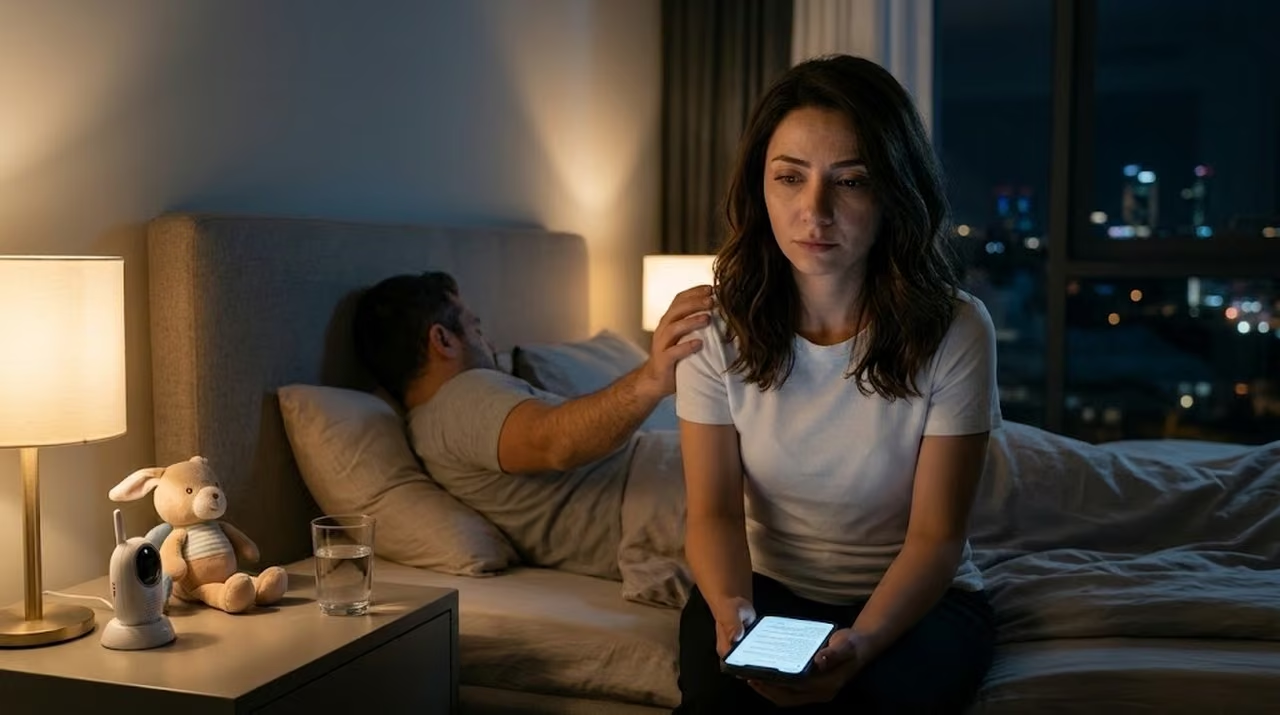
Photo: Yapay zekâ ile üretilmiştir
11:30 p.m. Arda has finally fallen asleep. Nil's daycare bag for tomorrow is ready. I've closed my emails. When I walk into the bedroom, my husband Ozan is awake, looking at me and smiling faintly. I smile faintly too. Then I get into bed, and the only thing going through my mind is: "Please, not tonight."
I thought a lot about whether to write this piece. Because this is something nobody says out loud. Yet it's something whispered about at the daycare door, in the office kitchen, at brunch with friends. That's why I'm writing it.
First, a confession
In the first year after Arda was born, Ozan and I were almost never intimate. We didn't fight, and we didn't stop loving each other. I just didn't want to.
Even "not wanting" isn't quite the right phrase. I felt nothing at all. No desire, no curiosity, none of that old excitement. My body had become a milk machine, a means of transport, an organism in search of sleep. My feminine side had retreated somewhere and closed the door behind it.
And worst of all, I blamed myself for it. "I'm being unfair to Ozan." "Is something wrong with me?" "Will I never be the way I used to be again?"
I wasn't the only woman who built these sentences. I learned that later, when I talked openly with a few mom friends.
Where does the libido go?
I'm not a doctor, and this isn't a medical guide. But there are a few things I've learned from my own experience and from the women I've talked to.
- The body changes. After birth and during breastfeeding, hormones are busy with something else. During that period a woman's body focuses on the baby. It's not a malfunction, it's a priority.
- Sleep disappears. For two years I didn't sleep a single night straight through. A person who isn't sleeping doesn't feel desire. She just wants to sleep. For a whole year, the bed was the most attractive place in the world to me, but only for sleeping.
- Body perception changes. When I looked in the mirror, I saw a mark on my belly, a different shape to my breasts, new lines on my hips. Ozan never minded any of it. But I did. A woman who doesn't feel attractive doesn't easily feel desire either.
- You're touched all day long. This was what I noticed last. Arda was in my arms all day, and Nil wouldn't let go of my hand. By evening, my body was saying, "Please, nobody touch me." I didn't even want Ozan's hand on my back. Apparently this has a name: "touched out."
- The mind never switches off. This may be the biggest one. Even in bed with Ozan, my mind was on tomorrow's meeting, on Nil's vaccination card, on the milk running out in the fridge. Desire needs the mind to go quiet. My mind never went quiet.

In my first piece I said "there is no such thing as a woman who manages everything." Let me say this on this subject too: a woman who manages everything has no energy left to manage her own desire.
What did Ozan feel?
I have to write this too, because this isn't a one-sided story.
Ozan never pressured me during that whole year. But I knew he felt something. Sometimes he reached out a hand and I turned over and went to sleep. Sometimes it was a little kiss and I said, "I'm so tired." And every time, something small went out in his face.

One evening, when Arda was about one and a half, we sat down and talked. Ozan said for the first time: "I started thinking you don't want me." And I said for the first time: "It's not you I don't want, it's anything. This isn't about you."
That conversation didn't solve everything. But it lightened the load for both of us. He stopped thinking he'd been rejected, and I stopped feeling guilty.
What changed, and how?
There's no magic formula. But a few things worked for me:
- Sleep first. Ozan and I agreed: two nights a week, he gets up for Arda. Sleeping uninterrupted those two nights reminded me that I was human. And a rested woman slowly starts remembering other things too.
- We shared the mental load. The problem wasn't just physical work. I was keeping the whole household list: daycare payments, doctor appointments, birthday gifts. Ozan and I split that list. As the lists in my head got shorter, room opened up for other things. The idea of "let's set the rules together" that I described in the mother-in-law piece worked here too.
- I set aside an hour for myself. One evening a week, after the kids are asleep, for me. A shower, a book, a face mask. Not a mother, not a manager, not a wife; just Begüm. In those hours I started to feel like a woman again.
- We redefined touch. Ozan and I agreed that not every touch has to be an invitation. Sometimes it's just a hug, sometimes just holding hands. Once that pressure was lifted, touch started to feel good again. I'd also read something similar in Aras and Lal's piece: intimacy often begins outside the bedroom.
- We put appointments in the calendar. Not romantic, I know. But twice a month, on a Saturday evening, the kids are at their grandmother's. Knowing ahead of time and preparing for that evening created anticipation in me. And anticipation, it turns out, is the first step toward desire.
- I consulted a specialist. It's important that I say this. At one point I felt not just unwilling but constantly unhappy. I went to my gynecologist, had my hormones checked, and met with a therapist for a few sessions. If the lack of desire you're experiencing in the postpartum period lasts a long time or comes with sadness, please don't carry it alone. It's not a weakness, it's a health matter.
To women
If you're saying "Please, not tonight" right now, know this: you're not broken. You're not a bad partner. This is a phase, and most of the time it passes.
But something has to be done for it to pass. Not staying silent, but talking. Don't tell your partner "I don't want you"; say "I'm not feeling anything right now, help me." The difference between those two sentences can save a marriage.
And stop blaming yourself. Libido is not a measure of how much a woman loves. It's a measure of how rested she is, how seen she feels, how at ease her mind is.
To men
Gentlemen, if your partner seems not to want you, first ask: "When did this woman last sleep her fill?"
Then ask: "Who keeps the household list?"
And finally: "When did I last touch her without expecting anything?"
The answers to these three questions are most often the answer to the silence in the bedroom. The way to bring back a working mother's desire isn't buying her more flowers; it's getting up for the child one night, remembering a doctor's appointment, washing the dishes one evening and saying "You go rest."
Ozan said this to me once, and I'll never forget it: "I want you back, but first share your exhaustion with me."
Begüm's short meeting notes
- Lack of desire isn't a malfunction, it's a signal. Sleep, mental load and body perception are all connected; as one improves, the others slowly improve too.
- Not "I don't want you," but "Help me." Changing the sentence helps your partner feel invited rather than rejected.
- If it lasts, don't carry it alone. Seeing a doctor or talking to a specialist is part of taking care of yourself.
Now it's 12:10 a.m. Ozan is asleep. I'm lying down next to him. Maybe not tonight. But Saturday is grandmother day.
Good night.



Comments